30 kW, 50 kW or 80 kW: Sizing Solar for a Business
Choosing the size of a commercial solar system is a balancing act. Go too small and you leave savings on the table; go too large and you export surplus power at a lower value, tie up cash and run…
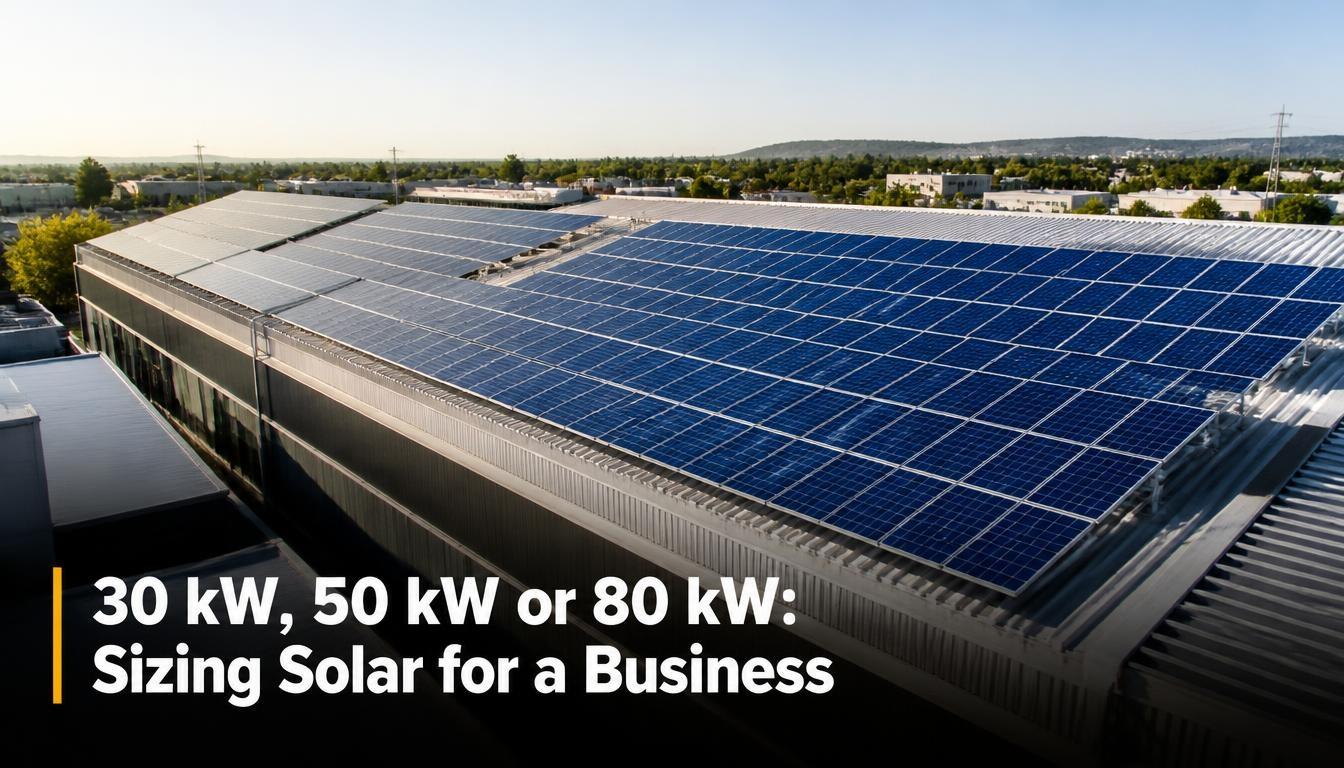
Choosing the size of a commercial solar system is a balancing act. Go too small and you leave savings on the table; go too large and you export surplus power at a lower value, tie up cash and run into roof limits. A 30kw solar system suits many shops, small factories and institutions, but depending on your load, a 20 kW, 50 kW or 80 kW system may be a better fit.
This guide shows what each size produces, what it can power, and how to pick the right one from your own bills.
How Much Does Each Solar System Size Produce?
A useful estimate for daily output is:
Daily kWh = system kW × peak sun hours × 0.75
The 0.75 factor covers real world losses from heat, wiring, dust and inverter conversion. The table below assumes 5 peak sun hours and 550 W panels, which are common in commercial installations.
| System size | Panels (550 W) | Roof space | Daily output | Monthly output |
|---|---|---|---|---|
| 20 kW | about 37 | about 100 m² | about 75 kWh | about 2,250 kWh |
| 30 kW | about 55 | about 145 m² | about 113 kWh | about 3,400 kWh |
| 50 kW | about 91 | about 240 m² | about 188 kWh | about 5,600 kWh |
| 80 kW | about 146 | about 380 m² | about 300 kWh | about 9,000 kWh |
Roof space is a rough guide of about 5 m² per kW on a pitched roof. Flat roofs and ground mounts need more room because panels are tilted and spaced to avoid shading each other. Your sun hours, roof angle and shading will change every figure.
What Can a 30kW Solar System Power?
A 30kw solar system produces roughly 113 kWh on a good day, which is enough to cover most of the daytime electricity use of a business that consumes about 3,500 to 5,000 kWh a month. In practice that can mean:
- A supermarket, restaurant or hotel kitchen with refrigeration and lighting
- A small workshop, bakery or printing business running machines during the day
- A school, clinic or office block with air conditioning in daytime
- A farm packhouse or small cold room
Because solar only produces power in daylight, a 30 kW system offsets daytime use. Operations that run mainly at night will need batteries to capture the same savings. If backup power is a priority, see our guide on solar plus storage for factories and farms.
20kW, 50kW and 80kW Solar Systems Compared
Here is how the neighbouring sizes typically fit:
- A 20kw solar system (about 75 kWh a day) suits small shops, clinics, small offices and light workshops with modest daytime loads.
- A 50kw solar system (about 188 kWh a day) suits small factories, hotels, larger schools and businesses with refrigeration or several machines running together.
- An 80 kW system (about 300 kWh a day) suits larger factories, cold storage, big institutions and operations with heavy daytime demand.
The jump from one size to the next is not only about output. Larger systems usually have a lower price per kW because fixed costs are spread over more capacity, but they also need more roof area, heavier cabling and a stronger electrical connection. To compare returns, see our guide on commercial solar payback and how to calculate it.
How to Choose the Right Size
Use your own bills to find the size, not the size of the building or what a competitor installed.
- Find your monthly kWh. Average your units over 12 months to smooth out seasonal swings.
- Estimate your daytime share. Ask what proportion of your power is used between about 8 am and 5 pm. For many businesses it is 60 to 80 percent.
- Calculate daytime kWh per day. Monthly kWh × daytime share ÷ 30.
- Divide by output per kW. System kW = daytime kWh per day ÷ (peak sun hours × 0.75).
- Check roof space and the connection. Confirm that the roof can take the array, and that the electrical supply and inverter match.
- Plan for growth. If you expect to add machines, air conditioning or an electric vehicle, leave room to expand.
Worked example (illustrative numbers only)
A business uses 4,500 kWh a month and 75 percent of that is in daytime.
- Daytime use: 4,500 × 0.75 = 3,375 kWh a month, or about 112.5 kWh a day
- System size: 112.5 ÷ (5 × 0.75) = 30 kW
That is exactly a 30 kW system. If the same business wanted to cover 100 percent of its monthly use, it would need around 40 kW but would export a lot of midday power or need batteries. Match the size to your goal, not just to your bill.
Practical Limits: Roof, Inverter and Grid
- Roof space and strength. Check the roof structure, condition and shading before choosing a size.
- Inverter sizing. Panel capacity is often slightly larger than inverter capacity, which is normal and cost effective, but your installer should set the ratio carefully.
- Three phase supply. Commercial systems of this size normally connect to a three phase supply, so confirm yours.
- Utility rules. Approval requirements and export rules vary with system size, so check them before you finalise the design.
- Warranties and service. Compare panel, inverter and workmanship warranties, and who services the system locally.
For the bigger picture of how commercial systems are designed and connected, see how commercial solar works for a business.
Conclusion
A 20 kW system suits small shops and offices, a 30kw solar system fits many mid sized businesses, a 50 kW system serves larger commercial loads, and an 80 kW system is built for heavy daytime demand. The right size comes from your daytime kWh, your roof and your goals, so start with your last 12 bills and let a certified installer confirm the design.
Ready to size your system? Work out your daytime kWh, then ask at least three commercial installers to quote the size that fits.